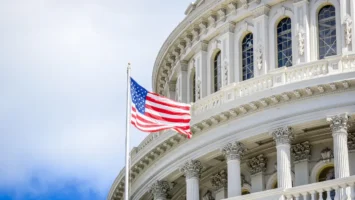
US technology shares fell sharply on Thursday, 5 November 2026, after Democratic gains in the midterms gave the party control of Congress and raised fears of tighter artificial intelligence rules, BBC News reported.
The Nasdaq reacts to midterm results
The sell-off was most pronounced on the Nasdaq, which includes technology companies such as Alphabet, Nvidia, Meta and Apple.
Investors reacted to the prospect of stronger Democratic opposition to President Donald Trump’s pro-AI agenda, while also questioning whether technology shares had become overvalued.
Market concerns had developed before the election, but the midterm results provided a new reason to reassess companies whose valuations depend on rapid artificial intelligence growth.
Democrats challenge data-centre expansion
Leading Democrats campaigned against the unhindered expansion of data centres, which provide the computing capacity needed to develop and operate many AI services.
Their objections include the facilities’ high consumption of electricity and water, alongside noise, land use and construction disruption affecting nearby communities.
With control of both houses of Congress, Democrats are expected to challenge the administration’s technology agenda more vigorously and could introduce measures limiting industry expansion.
Local opposition raises practical concerns
A Gallup poll published in May found that 71% of Americans would oppose a data centre being built in their community.
The figure exceeded the 53% opposing a nuclear power station, highlighting resistance to facilities that residents fear could affect household bills and local resources.
Those concerns give national political arguments a local focus, because new AI infrastructure can require substantial electricity, water, land and construction activity.
Texas elections test the industry’s plans
James Talarico, who won a Senate race in Texas, said the United States should protect its AI leadership while establishing clear, consistent laws for businesses.
Texas governor-elect Gina Hinojosa campaigned against data centres and pledged a moratorium on constructing new facilities, creating a potential obstacle in a major technology state.
Hinojosa’s position could also challenge Elon Musk, whose SpaceX and Tesla operations have expanded in Texas after he spent nearly $450m supporting Republican midterm campaigns.
Investors want evidence of future returns
Goldman Sachs research estimated that AI investment could reach $1tn in 2026, covering computer chips, networking infrastructure, data centres, energy and AI development.
The investment surge followed OpenAI’s release of ChatGPT in late 2022, which helped drive widespread public and corporate interest in practical AI applications.
Tudor Brown, co-founder of British technology company Arm Holdings, said stock values are based on future earnings rather than present earnings, leaving investors focused on whether expected rewards justify current prices.
While we want to protect America’s leadership in artificial intelligence, we are still grappling with how it will affect everything from how we work to how our children learn.
James Talarico, Texas Senate-elect
The next test will be whether Democrats pursue measures restricting data-centre expansion after taking control of Congress, while companies try to demonstrate that AI infrastructure can deliver expected returns.
Investors will therefore be watching both Washington’s regulatory response and evidence from technology firms that their spending can produce stronger earnings.
Related Coverage